US business hours
Custom quote per dedicated agent. One-agent minimum. Default hours are US Eastern; we confirm the exact window with you.
Compare · Pricing
How a dedicated seat is quoted, a sourced US in-house benchmark, and how per-ticket and per-hour BPO models work — without invented market averages.

Most teams shopping for outsourced customer support pricing are trying to answer a simple question: what will it cost to have someone reliable on the queue, and is that better than hiring in-house or buying a pool of tickets? The models are not interchangeable. A dedicated monthly seat, a US employee, a per-hour contract, and a per-ticket BPO all price different things.
This page explains how we quote a dedicated seat, uses a U.S. Bureau of Labor Statistics benchmark for in-house wages and benefits, and gives a plain-language description of per-ticket and per-hour models. We do not quote a “typical industry price” unless we can point to a primary source. For the full offer, see the pricing page. If you are still deciding whether to outsource at all, start with the in-house vs outsourced guide.
BE Simple Staffing provides dedicated customer support agents through our established partner team in Prishtina, Kosovo, for US small businesses. You are buying a named seat on your brand, not minutes in a shared pool.
Custom quote per dedicated agent. One-agent minimum. Default hours are US Eastern; we confirm the exact window with you.
A custom option, quoted case by case on top of the usual US East Coast hours. Hours are scoped on the call.
Custom quote. AI handles routine questions; a dedicated agent takes the conversations that need judgment.
Agreements start with a three-month term and then go month-to-month. Our go-live target is about two to four weeks, not a guarantee. The monthly rate includes recruiting, onboarding, brand training, tooling setup, supervision and quality assurance.
The AI + human hybrid seat is also a custom quote. The written quote lists exactly what is included.
The in-house number we can stand behind is a public one. The U.S. Bureau of Labor Statistics Occupational Employment and Wage Statistics puts the national median wage for customer service representatives at $44,770 a year (May 2025, occupation 43-4051). That figure is wages only.
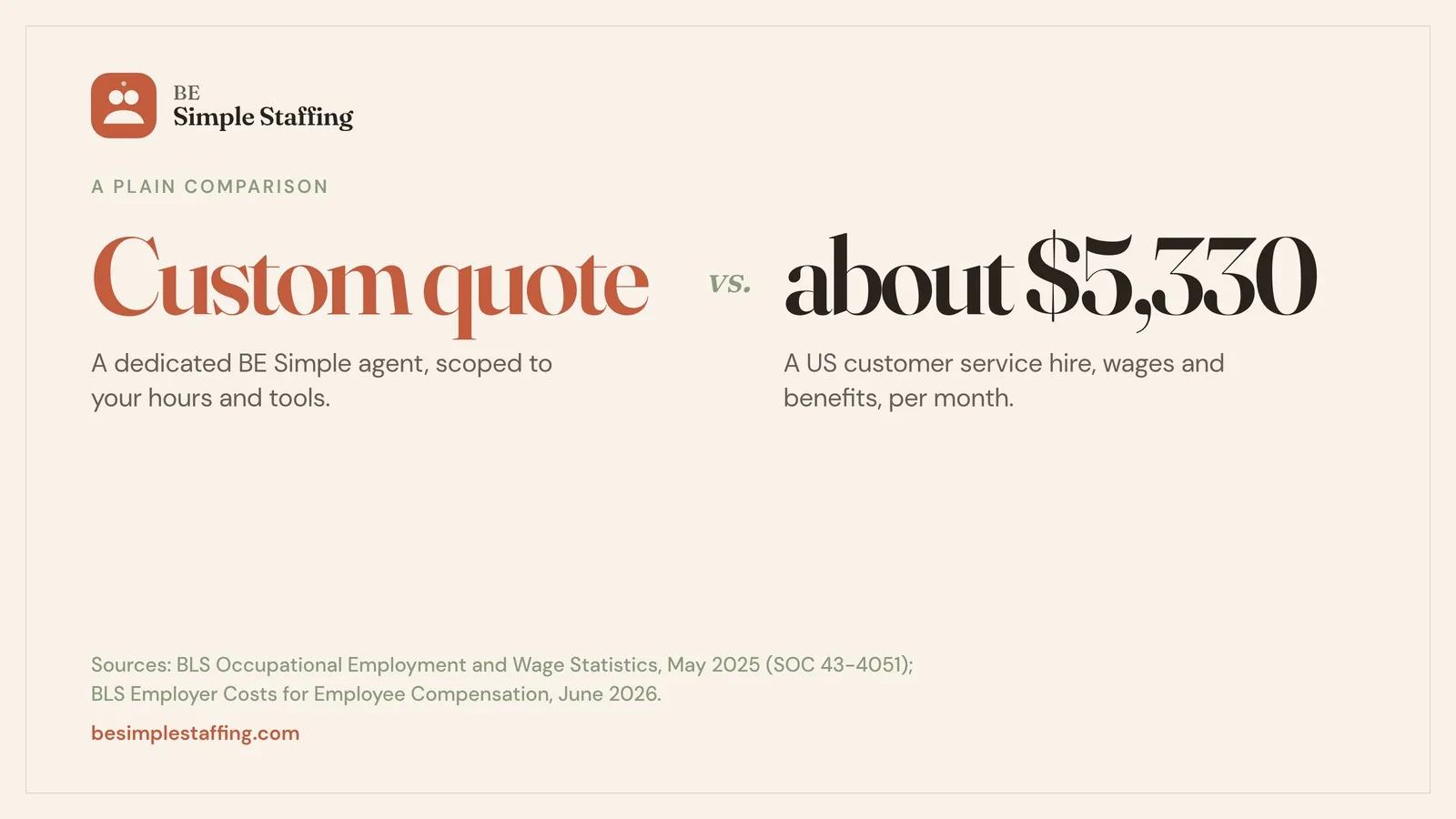
In June 2026, the BLS Employer Costs for Employee Compensation report found that benefits made up 30% of total compensation for private-industry workers, which means wages were 70% of the total. Applied to that median wage, pay plus benefits comes to about $64,000 a year — roughly $5,330 a month. It still does not include recruiting, a laptop and software, or the time to manage the person.
A dedicated business-hours agent with BE Simple Staffing is a custom quote, all-in. Any gap against a US hire is largely about the cost of living, not a claim about lower skill. Your local US wages may be higher or lower than the national median, and an in-house hire still has a place — we cover that honestly in the decision guide.
| Line item | US in-house hire (BLS-based) | BE Simple business-hours seat |
|---|---|---|
| Monthly cost | About $5,330 in wages and benefits | Custom quote, all-in |
| Annual cost | About $64,000 in wages and benefits | Custom quote |
| What that includes | Pay plus typical private-industry benefits. Not recruiting, equipment, software, or management time. | Dedicated agent, recruiting, onboarding, tooling setup, supervision and QA. |
| Term | You employ the person; costs continue while they are on payroll. | Three-month start, then month-to-month. |
Sources: BLS OEWS, May 2025, SOC 43-4051, national median wage $44,770; BLS ECEC, June 2026, private-industry benefits at 30% of total compensation. $44,770 ÷ 0.70 ≈ $63,957 a year, or about $5,330 a month. BE Simple pricing is a custom quote.
Dedicated seats are not the only way to buy support. Two other models show up constantly in vendor conversations. Published price lists for those models vary widely by region, channel, and complexity, and many “average rates” on vendor blogs cannot be traced to a primary source. Rather than repeat unsourced ranges, here is how the models actually work, and what to watch for.
You pay for time on your account — scheduled hours, logged-in hours, or productive hours, depending on the contract. This can fit a short campaign, a seasonal overflow desk, or a trial of outsourcing without standing up a full-time seat. Ask what an “hour” means, whether training and meetings are billable, and what happens when volume drops mid-month. A low hourly rate can still cost more than a seat if you are paying for idle time, or if after-hours work carries a premium.
You pay each time a contact is closed or an issue is marked resolved. This can fit low or spiky volume, when a full-time seat would sit underused. The trade-off is the incentive: a provider paid per closed ticket is paid to close tickets, not necessarily to solve harder problems well. Ask how a reopened ticket is counted, whether a long technical thread costs the same as an order-status question, and who handles escalations that are not “tickets” in the usual sense. Past a steady volume, a dedicated seat is often the simpler cost to forecast — run your own monthly ticket count against a seat rate rather than trusting a generic breakeven claim.
Some per-hour and per-ticket programs use a shared queue: whoever is free takes the next conversation, often across several brands. That can be a reasonable way to cover a thin after-hours trickle. It is a poor fit when brand voice, product knowledge, or tool access matters. Our model is the other kind: dedicated agents who train on your catalog, policies, and helpdesk, and stay with your customers.
| Situation | Model that usually fits |
|---|---|
| Steady daily volume, brand voice matters | A dedicated monthly seat. Start with one business-hours agent if most contacts arrive during the US day. |
| Evenings, nights and weekends | A custom option, quoted case by case on top of the usual US East Coast hours. Extended coverage needs a rota of several agents so no one is stretched thin. |
| A short seasonal spike | Per-hour overflow, a temporary seat, or a planned add-on to an existing dedicated team. A three-month dedicated term is a poor fit for a two-week rush by itself. |
| Low, unpredictable volume | Per-ticket or a shared after-hours service can be rational. Revisit the math once volume is steady enough to fill a seat. |
| Many repetitive questions, plus messy edge cases | An AI and human hybrid, if the AI is actually resolving routine work and a person is available for the rest. Confirm what happens when the AI cannot help. |
Pricing is only half the decision. These use-case pages describe the actual queue in each industry, with a free playbook if you want to think it through first:
If you want a location comparison as well, read Kosovo vs the Philippines vs Latin America. Or write to us with your volume, hours, and tools.
It is a custom quote, scoped to your hours, coverage (usually US East Coast hours, with evenings, nights and weekends as a custom option, or an AI and human hybrid) and tools. Book a free 30-minute call to get one. Agreements start with a three-month term and then go month-to-month. Extended coverage is staffed with several agents.
The U.S. Bureau of Labor Statistics puts the national median wage for customer service representatives at $44,770 a year (May 2025, occupation 43-4051). Benefits made up 30% of private-industry compensation in the June 2026 ECEC, which brings pay plus benefits to about $64,000 a year, or roughly $5,330 a month. That figure still does not include recruiting, equipment, or management time. A dedicated business-hours seat with us is a custom quote, all-in. Your local US wages may be higher or lower than the national median.
A dedicated seat is a monthly rate for a person assigned to your brand. Per-hour pricing bills for time spent on your queue, which can suit short campaigns or uneven schedules. Per-ticket or per-resolution pricing bills each closed contact, which can suit low or spiky volume but rewards closing tickets quickly. Those models are useful in the right situations; they are a different product from a named agent who learns your tools and stays with your customers.
Our default US business-hours window is Eastern time. We confirm the exact hours with you before a team starts. Agents on our established partner team in Prishtina cover that window on a later local shift — typically mid-afternoon into the evening in Kosovo.
The hybrid seat is a custom quote, like every other seat. The written quote lists exactly what is included.
The monthly rate includes recruiting, onboarding, and tooling setup. The agreement starts with a three-month term so the team can be hired, trained, and settled, then runs month-to-month.
What a dedicated seat costs versus a US in-house hire, and how per-ticket and per-hour BPO models work.
Time zone overlap with US Eastern, language context, and cost factors — using sourced facts only.
An honest decision guide, including when you should not outsource.
Who employs them, who manages them, and when each is the better fit.
Three terms that sound alike and describe three levels of responsibility.
Tell us about volume, hours, and tools. We'll come back within a day with a clear, simple proposal.